Do you need a good overview of all important websites regarding Robot Framework? Find my strategic link collection here:
Good introduction and overview on wikipedia: https://en.wikipedia.org/wiki/Robot_Framework
Quick start: https://github.com/robotframework/QuickStartGuide/blob/master/QuickStart.rst
My general considerations on robot Framework: https://it-kosmopolit.de/robot-framework-is-a-programming-language/
Install Robot Framework with IronPython on Windows: https://it-kosmopolit.de/install-robot-framework-with-ironpython-on-windows/
Use .NET libraries in Robot Framework: https://it-kosmopolit.de/use-net-libraries-in-robot-framework/
RIDE (Robot Framework IDE/development environment): https://github.com/robotframework/RIDE
User guide/tutorial with a lot of content: http://robotframework.org/robotframework/latest/RobotFrameworkUserGuide.html
Ask you questions here: http://stackoverflow.com/questions/tagged/robotframework?sort=newest&pageSize=30
Installation instructions: https://github.com/robotframework/robotframework/blob/master/INSTALL.rst
The source code (repostiory) on gitHub: https://github.com/robotframework/robotframework
Use .NET libraries in Robot Framework
With Robot Framework on IronPython (Install Robot Framework with IronPython on Windows) you still implement the keywords in Python, but you can seamlessly access the wealth of .NET-libraries.
An example is worth a thousand words; so find an example how to use System.IO.File from .NET to create a file:
1.) IronPython (Python on .NET) file:
import System
class FileManager:
    def create_file(self, fileName):
        System.IO.File.Create(fileName)
… save as C:\Program Files (x86)\robotframework-2.9\src\bin\FileManager.py
2.) Robot Framework file:
*** Settings ***
Library    FileManager
*** Test Cases ***
My Test
    Create File    fantastic.txt
… save as C:\Program Files (x86)\robotframework-2.9\src\bin\ExampleTestCase.txt
The Keyword „Create File“ in this .txt is automaically matched to the create_file method from the Python file. The underscore is automatically „translated“ to a space.
3.) Execute in cmd:
cd C:\Program Files (x86)\robotframework-2.9\src\bin
ipybot ExampleTestCase.txt
Finished! Find fantactic.txt in C:\Program Files (x86)\robotframework-2.9\src\bin.
For more information on Robot Framework read: https://it-kosmopolit.de/strategic-link-collection-of-robot-framework/
Wann ist Windows am dd.MM.YYYY hochgefahren / runtergefahren
Windows 10
Eine entsprechende Anleitung für Windows-Hochfahren und Windows-Runterfahren events habe ich bislang noch nicht gefunden.
Workaround: Wer seine Arbeitszeiten am Hoch- und Runterfahren des Computers an einem bestimmten Tag ermitteln möchte, kann sich auch eines anderen Ansatztes bedienen.
- Drücke die Windows-Taste, gebe „eventvwr“ ein & bestätige.
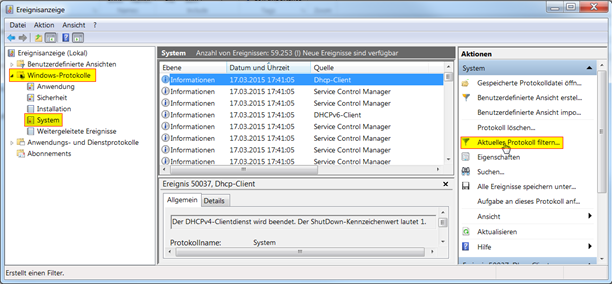
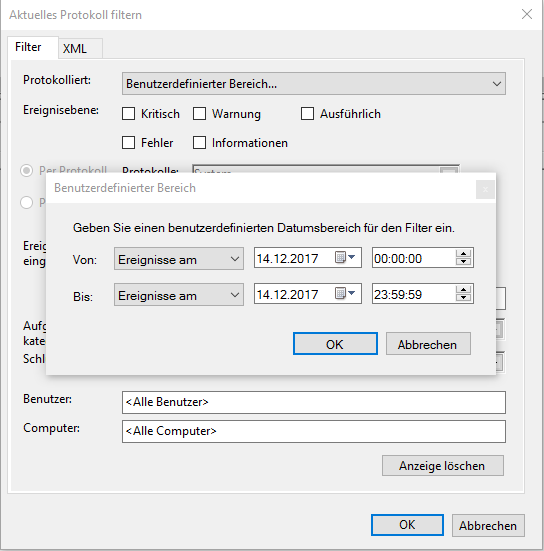
- Klicke auf Windows-Protokolle -> System -> Aktuelles Protokoll filtern:
- Aktuelles Protokoll filtern auf den entsprechenden Tag einstellen und die Uhrzeit des ersten Events und die Uhrzeit des letzten Events beachten:
Windows 7
Folgende Methode funktioniert in Windows 10 nicht (Begründung)
Das kennst Du auch: Du hast vergessen zu stempeln und willst wissen, wann Du zur Arbeit gekommen bist. Folgender Trick hilft Dir dabei:
Meistens fahren Büromenschen, wie ich, den Computer am Morgen hoch und am Abend runter (aus Brandschutzgründen). Windows speichert beide Ereignisse und so kannst Du diese ermitteln:
- Drücke die Windows-Taste, gebe „eventvwr“ ein & bestätige.
- Klicke auf Windows-Protokolle -> System -> Aktuelles Protokoll filtern:
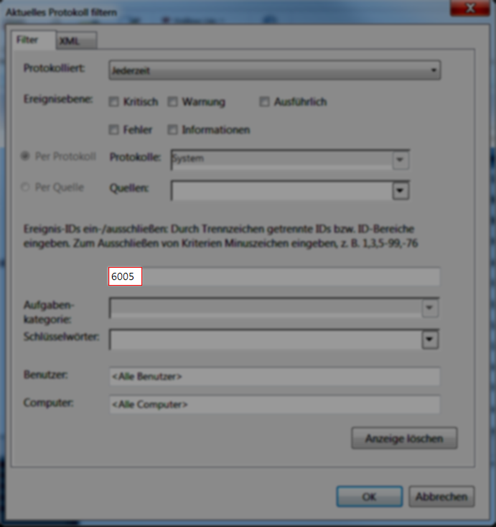
- Im Feld <Alle Ereignis-IDs> gibst Du 6005 für die Windows-Startzeiten ein oder 6006 für die Herunterfahr-Zeiten:

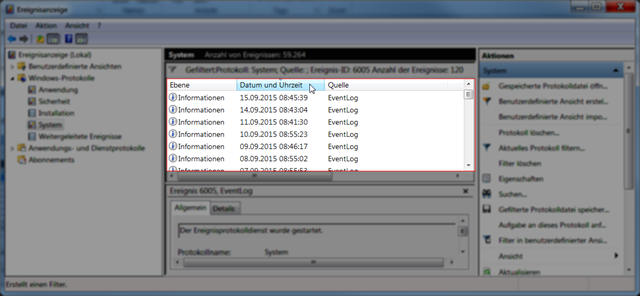
- Jetzt sortierst Du nur noch nach „Datum und Uhrzeit“ und Du bist am Ziel: