WordPress: Installation auf Deinem Computer/Server

Das Installieren von WordPress ist ganz einfach, auch wenn so manche im Internet umherirrende Anleitung etwas anderes suggeriert.

0.) Voraussetzung: Du hast einen laufenden Webserver der an Port:80 lauscht.

1.) WordPress herunterladen & entzippen.

2.) Inhalte vom Webroot-Ordner löschen & Inhalte vom Ordner /wordpress in den Webroot-Ordner verschieben.

3.) wp-config-sample.php in wp-config.php umbenennen.

4.) Datenbank und Datenbank-User anlegen und diese in wp-config.php eintragen. (Mit Plesk geht das über Websites&Domains -> meine Domain -> Datenbanken -> Neue Datenbank hinzufügen)

5.) Rufe http://localhost auf, fülle das Formular aus, notiere das Passwort & klicke „Install WordPress“. (Bei Plesk habe ich keine Möglichkeit gefunden, auf diese Startseite direkt zuzugreifen – also muss ich auf die erfolgreiche Domain-Konnektierung (Anleitung für Host Europe) warten.)

6.) Einloggen.

Install Robot Framework with IronPython on Windows

… or how to get YOUR Robot Framework test-report in less than 10 minutes!

Notes

Installation architecture

ironPython-robot-framework-architecture

Install Robot Framework from Source Code

1.) Download & install IronPython http://ironpython.net/download/
2.) Install elementtree (because it’s broken in current IronPython: https://github.com/IronLanguages/main/issues/968):

cd C:\Program Files (x86)\IronPython 2.7
ipy setup.py install

3.) Install Robot Framework:

cd "C:\Program Files (x86)\robotframework-2.9"
"C:\Program Files (x86)\IronPython 2.7\ipy.exe" setup.py install

4.) Add

C:\Program Files (x86)\IronPython 2.7;

to the PATH-variable.
5.) Restart cmd & check for success:
cd "C:\Program Files (x86)\robotframework-2.9\src\bin"
ipybot --version

ironpython-robot-framework-version

Run an example testcase

1.) Save

*** Test Cases ***
My Test
Should Be Equal 1 1

as Example.txt in C:\Program Files (x86)\robotframework-2.9\src\bin
2.) Execute in cmd:
ipybot Example.txt

Create a test-report

1.) Execute in cmd:
ipyrebot output.xml
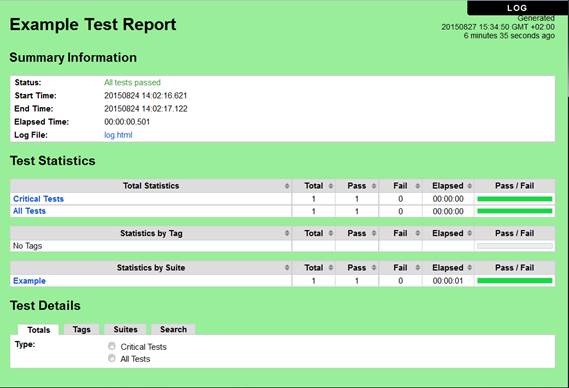
2.) Open report.html and enjoy the result:
robot-framework-ironpython-success
For more information on Robot Framework read: https://it-kosmopolit.de/strategic-link-collection-of-robot-framework/

Highlight element in Internet Explorer (xPath)

Because missing proper xPath tool support in Internet Explorer, you have to Do It Yourself.
It feels dirty, but you get used to it 😉
1.) Open www.google.com in Internet Explorer & press F12 (to open developer tools)
2.) Open console-tab and execute following javascript:

var script = document.createElement("script");
script.src = "http://selenium.googlecode.com/git-history/f0245c5918a5ee98e25e47b3e08746eb7fd1a0ee/src/main/resources/core/xpath/javascript-xpath-0.1.11.js";
script.setAttribute("type","text/javascript");
document.body.appendChild(script);

If prompted, decide for „Show all content“ …
Internet-Explorer-xPath-warning
… than execute this javascript again. If you are prompted again, then execute the javascript again. Do this as long as the prompt appears.
Choose your xPath and execute:

var xPath= ".//*[@title='Google']";
var myElement = document.evaluate(xPath, document, null, XPathResult.FIRST_ORDERED_NODE_TYPE, null).singleNodeValue;
myElement.style.outline="3px solid red";
myElement.style.border="3px solid red";
myElement.style.opacity=1;
myElement.style.visibility="visible";
myElement.style.zIndex="2147483647";
myElement.style.overflow="visible";

Et voila, your evaluation of Internet Explorer’s xPath:
Internet-Explorer-xPath-success
My frist reader, who can add the scroll-to-that-element feature wins a backlink 😉
Notes:

  1. If no element was found, the thrown exceptions may differ from time to time and are somehow cryptic. You have to get used to that.
  2. This hack was tested with Internet Explorer 9 & 11
  3. Find similar hacks: https://autumnator.wordpress.com/2013/05/02/testing-xpath-and-css-locators-firepath-style-across-browsers/
  4. Supports working in test-automation, e.g. with Selenium

Anpacken!